I’m a Photographer Who Doesn’t Chase Gear—Here’s Why

What makes a great picture has nothing to do with price tags.

I'm never the gearhead type of photog. I don't care what just came on the market or which lens is the sharpest. I'm not reading gear blogs or fighting sensor specs in forums.

I've always approached photography as an art form first, above all. In my eyes, tools are tools—a bridge connecting what I feel and what I'd like to communicate with the outside world.

The Tools Serve the Vision—Not the Other Way Around

Yes, I've upgraded my camera once or twice—but always for utility reasons. My recent change wasn't about status or specs. I needed something compact, quiet, and beneficial. A camera that I could keep in my pocket and in my life.

That's how I operate:

Under the radar. Intuitively. With tools that enable the moment, not dominate it.

"Hand an amateur a Leica and a pro a point-and-shoot—the pro will still make the better image."

It's not the tool. It's the eye.

Asking Picasso what kind of brush he used. That would not make a difference. Because he did make a difference. The eye. The instinct. The heart of the work.

I Shoot How I See: Real, Honest, Unfiltered

Something else about me—I don't over-process my photos.

I might make a tiny adjustment here or there, but overall, what you're looking at is what I was looking at. And that's intentional.

I want to document life as it happens.

Real. Flawed. Authentic.

While going through hundreds of thousands of vintage photos—photos which never were retouched—I discovered that's the kind of photography that resonates with me. The not retouched. The real. The imperfect.

And honestly?

It pains me to see faces photoshopped into plastics.

Parents photoshopping themselves out of visibility in photos with their kids. One day, those kids will look back—and they won't even register the real people who brought them up. That's not just sad. It's erasure.

I Care Deeply—But I'm Not Rigid

I care deeply about what I do. But I'm designed to do it loosely.

I had one client who wanted each shot to be absolutely perfect in-camera—no angling, no cutting. That was not how I work. I tried it. It felt like they were asking me to do another's process instead of using my own.

I am always eager to work with someone.

If a customer is not satisfied with my edit? I'd be happy to deliver the RAW files for a small extra fee. It's about trust. And trust is founded on respect—for the way I visualize, the way I photograph, and the way I understand the moment.

For the past five years, I've also steered clear of cropping client photos. I send them full-sized. Why? Because how someone may use a photo can shift. And I'd rather leave that to them.

I'm Not a Content Creator. I'm a Storyteller.

Fads rise and fall—faster than ever.

I don't go after them. I never have.

The pros I admire don't either.

Maybe trends are wonderful for clicks. Maybe they do actually work on social.

But that's not the reason I'm here.

I'm not an influencer.

I'm not a content creator.

I'm a feeler. A storyteller. An artist.

And I create things because I want to, and for the people who actually get what I do.

"The best camera is the one you have with you."

That's another mantra that I live by.

And so it's true. To everybody, that is a phone. And for goodness' sake, that's good enough. I have photographed colleagues who take excellent pictures of their work on their phones. It's not about what you're holding—just what you're looking at.

Final Thoughts

If you're wondering whether or not your gear is good enough—

Let me give you a time-saver:

It is. You are.

Don't let perfectness stand in the way of your expression.

Start where you are.

Use what you have.

Feel everything.

And shoot like it counts—because it does.

Found by the Past: How I Grew Up with Antiques, Art, and a Special Interest in Forgotten Photos

I've lived surrounded by old and antique things from as far back as I can remember. My father's a dealer—it started with cameras, before all of that turned digital. He used to sell film cameras, books, lenses, old photography bric-a-brac—anything related to taking pictures in the pre-digital days.

He was a photographer first, and I was his stand-in or model sometimes when he needed to rehearse a shot for furniture or portraiture. I was just his helper otherwise—loading the van, rearranging chairs, or setting up a booth. Our weekends were not spent watching football games or movie nights—they were spent estate-selling, browsing antique shops, flea-marketing, and visiting museums.

I was surrounded by objects that had already lived whole lives by the time I brought them into my hands.

My parents say my first profession was as a junk-picker—just like my old man. And honestly? They were correct. Fast forward to today, and you could call me a creative junk-picker, I guess. I find beauty and potential in what others discard.

My own initial real "collection" was fossil rocks—little ones that you'd notice along creek beds or on the side of the road. My dad even gave me a cabinet to put them in. I obsessed over the textures, the age they were from. Already, maybe I understood that things tell stories, even though they can't talk them out loud.

I was also a Legos person. They weren't collectibles to me—more like a language. I could build, re-arrange, bring whole worlds to life. I regret that I let people bully me out of that. I would have likely built incredible things by now. But that is another story entirely.

About five years ago, something creatively changed. I started working on what I've termed my Modernized Painting Series. I take old images—perhaps photographs or paintings—and I tamper with them. Maybe I cover faces with colored dots in a panoramic photo, or abstracify parts of a 19th-century print. It's a visual interrupt. A way of both honoring and challenging memory, identity, anonymity.

That's when I got serious about collecting. I started going to estate sales regularly—not just with my father, but as my own person. I started shopping for material to use in artwork, to sell, and to be honest, the excitement of searching. You never know what you'll find, or who you'll meet. The community is small and intricately intertwined, and soon I started running into people who knew my father—or had heard of me because of him.

I was getting bored one evening and started digging deeper online. And that's where I ended up in this huge, lively community of vintage photography collectors and dealers—mostly through Facebook groups. I was already buying on eBay and Etsy, but this was different. It was more personal. You could swap, message people, listen to the histories behind the collections.

Since then, I've been buying, scanning, cataloging, trading, and occasionally selling old photographs. I scan most of everything. I dream of building this massive source library—something artists, creatives can draw from for inspiration, repurpose, or just look back at. I keep a lot of the hard copies, to sell, to display, to integrate into new work later.

Some people have given me photos for free, and I’ve done the same. There's a kind of barter system in this world, one based not only on value but on shared reverence. These aren’t just images—they’re fragments of lives that might’ve otherwise vanished. Preserving them feels like an act of care.

I still go to sales. I still post online that I am looking. I still get excited at the unknown of what an old attic is going to yield.

And having been diagnosed for autism, I learned the language for what all this is:

It's my special interest.

It's a thing I find myself going back to over and over. The thing that never, ever fails. The thing I could talk about endlessly, obsessively plan, and get lost in until time ceases to have meaning.

And beyond that—it's who I am. This obsession with lost photos, lost things, lost individuals. it's how I get time to fit. It's how I connect when words fail.

To others, they're nothing more than dusty old photos.

To me, they're snapshots of presence.

Even if no one remembers their names.

The Diagnosis Didn’t Change Me—It Helped Me Translate Myself

For most of my life, I knew that I was different—but I never could put my finger on why.

When I was younger, I was in extra help classes. I did have a small group of school friends, but too often felt like I was outside the group. I hid alot—especially my depression. I would write constantly in a journal, telling things I could not tell people out loud. I even remember, about ten years or so ago, having to tell people that I needed to have my head scanned. I needed to know how my brain functioned. I knew something wasn't quite right—not that there was anything wrong, exactly, just in a way that didn't fit everyone else.

After I had the mental health breakdown, the idea of testing came back stronger than ever before. This time, however, my family did not brush it off. We started calling—working through numbers, names, and waitlists. Eventually, through a relative, we were matched with a woman who had done state-level work performing autism assessments and was halfway through her retirement.

Before even testing me, she met with my parents. They came armed with scribbled journals, Facebook posts, and even my IEP—which, ironically, was going to be purged the following week. Following that meeting, she handed my dad a book on autism and instructed him, "Read this." He did. And having read it—and reviewed my IEP—he said to me that it was reading the same person.

That's when everything changed. My dad knew.

It was a surprise to everyone. Therapists, school officials—none of them were catching on. But in hindsight, it was all there. Just. concealed. Misunderstood.

And then the testing. Two consecutive days. The first one was a killer—two hours of constant cognitive and mental testing, something I hadn't seen since high school. It was hard. But necessary. After working my way through everything, she sat with me and said it to me: I'm on the spectrum. She just had to write it down.

When I got the confirmation, I texted some close friends and relatives. All of them told me the exact same thing: "You're still you. We accept you. We love you." That was grounding. It informed me that a diagnosis is not a new name—it is simply a better name for what has always been.

It helps others understand me. Helps me understand me.

It describes the strangeness that I just can't seem to get a handle on. The overwhelm. The hyperfocus. The social burnout. The re-watching of the same videos repeatedly. The ordering of things just so. The emotions that come out sideways. The silences that aren't empty.

After diagnosis, I dove in. Books, podcast episodes, videos, discussing with those who've walked this way before. I started paying attention to so many things I've done or still do. None of them are strictly "autistic things"—there are lots of human things. But I've come to understand that autistic actions are on the same continuum as neurotypical ones—merely more intense, or less masked.

One word that has lingered with me: neurospicy. I appreciate it. It adds some color to the clinical. It fits.

And through all of this—before, during, and after diagnosis—I’ve been telling parts of this story publicly. Mostly through my Instagram stories, and long posts that feel more like open journal entries. For years, I’ve been posting as a way to say “I need help” without saying it directly. I’ve left breadcrumbs. Not everything. But enough that if someone’s watching closely, they can feel what I’m feeling.

My website, on the other hand, is the reverse of all that confusion.

Where social media is a trash dump—emotional, cluttered, unedited—my site is tidy. Thought out. Systematic. It's my portfolio, but also my introverted self-portrait. It's all that I couldn't say when I didn't have language, or couldn't talk fast enough. It's the me that says: Here. This is what I perceive. This is how I feel. This is what I produce when the clamor at last subsides.

Since the diagnosis, I've also been contemplating masking a lot more. That's an entire other level I haven't entirely explored. I know I mask—I always have to some extent. Especially out in public, around groups, in "professional" environments. But simultaneously, I've never actually felt like I wasn't me. Just a me attempting not to be a bother to other people.

Unmasking, for me, is slow. I’m still figuring out how much is performance and how much is adaptation. Still learning what it means to feel safe enough to show up fully, and how to spot the difference between authentic connection and just being tolerated.

This whole journey—getting tested, receiving the diagnosis, making art, reshaping my digital presence—has been like putting together a collage. Bits of my past, my thoughts, my habits, my dreams. Cut up, reshuffled, glued back together. And somehow, despite the mess, it forms something real.

I’m still learning. Still questioning. Still processing.

But I’m not hiding anymore.

This is my mind. This is my art. This is my life—neurospicy and all.

I Purged My Studio and Found Myself Again: The Art of Letting Go

Last year alone, I've done two studio clean-outs of epic size. After almost giving a year's worth of painting up—and trying to sell off on older work—at last, I found myself in the situation where I couldn't help but ignore the fact: much of what I'd been accumulating simply no longer resonated with me.

Some of it was like ghosts of old selves. Some were like artistic detours without destinations. I chose to release the work that didn't belong to me anymore. And not just the work—equipment, material, drawings, canvases, pieces of paper. All that maybe-someday work I was clinging to habit or shame.

I decided that I want to work on a bigger scale from now on. Bigger canvases, greater leeway. The smaller ones can still be included in the mix—especially for pieces updated or photo-based—but in general, I'm done thinking small. That goes for both the art and my thought process.

I've had this cleaning compulsion every now and then. To strip things bare. Every now and then I'll catch myself thinking, maybe it's because I'm afraid of being a hoarder. I'm not—not by a long way. But I have worked in hoarder homes. I've seen firsthand what happens when creative energy gets turned inward and gets stuck. I don't want that for myself.

All the same, I do and don't have much. It's all relative. Over the years I've given away, donated, or sold off an enormous quantity of things. Books to free libraries. Art supplies and other materials to those friends of mine who require them. I might have made more money if I'd sold everything—but sometimes it just feels better to give.

I won't deceive you. There are a few things I do regret giving away. A fragment of which I miss. A book of which I wish I still owned. And certainly some money regrets, as well. But some of this is learning to live with that. To remind myself: someone else might be in greater need of it than I am. And I still have the memory, the story, the version of the thing in my mind. That's a kind of preservation, too.

To help with releasing, I've started documenting things—taking photos of things before releasing them. It's a small ritual that soothes me. If I want to revisit, I can. If I want to remake, I'll have a path to follow.

Releasing is now a part of my process. It's clearing space—physically, but mentally and emotionally as well. It's what makes the work honest. It makes me honest.

And every time that I let something go, I remind myself: it's not lost. It just changed hands. Maybe it'll have a new life somewhere else. Maybe that letting go will come back to me in some different guise.

Some think that kindness comes back tenfold. I don't know if it always does. I do know, though, that releasing the things which no longer fit is the only way to make space for what comes next.

And I'm ready for what comes next.

The Art of the Atmosphere — Staging with Julian Porcino

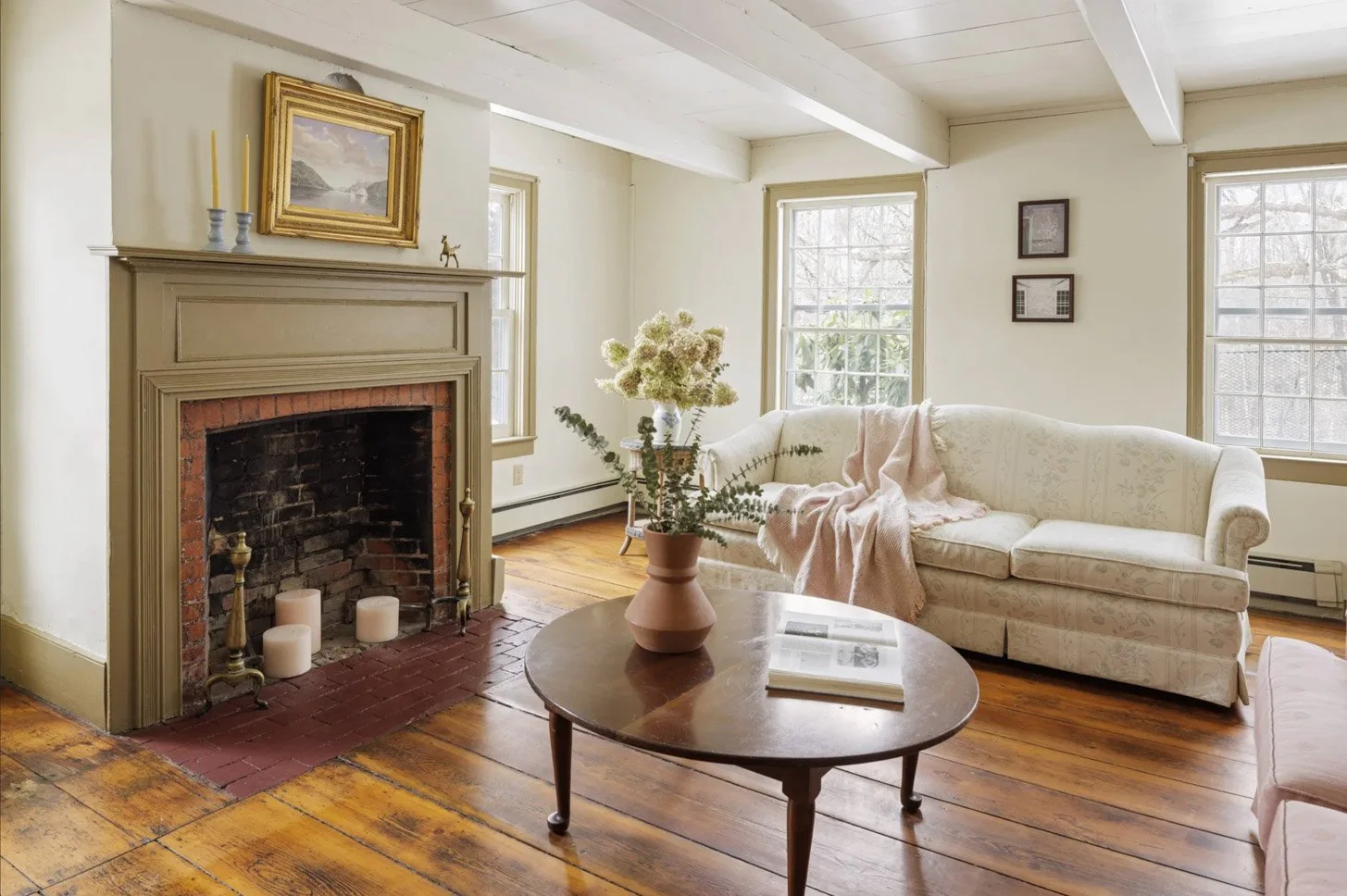
Over the past few months, I’ve been working alongside Julian Porcino on home staging projects, and it’s quickly become one of the most creatively fulfilling parts of my life. Julian’s work isn’t just about aesthetics — it’s about presence, intention, and creating spaces that feel aligned, calm, and full of life.

We’ve worked on homes in Columbia County (where we’re both based), New York City, and the Berkshires — each with its own rhythm and personality. Whether it's a rural farmhouse or a city apartment, the process is rooted in the same principle: listening to the space and letting it speak.

Personally, I love the full range of it. Moving furniture around, digging through someone’s home to see what they already have, noticing what can be used in a new way. There’s something special about finding character in a forgotten object — giving it new meaning just by changing its placement.

Julian has a sharp and soulful eye, and what I appreciate most is how collaborative he is. He asks for my opinion, lets me style corners, and values the way I see things. It’s not just about filling a space — it’s about building a feeling together.

I’ve also started sourcing pieces for him — vintage items, art books, small objects with texture and soul. And lately, I’ve been painting abstract works that have ended up in some of the staged homes. Seeing them on the walls feels quietly powerful. Like leaving a small part of myself in a space that’s about to become someone else’s future.

Beyond staging, Julian is also a licensed real estate agent and a breathwork facilitator — which honestly makes a lot of sense. His work is holistic: body, space, energy. It’s about helping people feel more connected, more grounded, more in tune with what they want from the places they live in and move through.

(Insert photos here: your artwork in the homes, styled moments, sourced objects, photos of you and Julian at work.)

If you’re looking to transform a space — whether for selling, settling in, or just finding a new sense of balance — I’d love to connect. I bring a careful eye, a love of details, and a real joy in helping create rooms that feel right. And if you’re interested in working with Julian, I can’t recommend him enough.

Learn more about Julian’s work here:
🔗 Instagram – @julianporcino
🔗 Website – julianporcino.com

Photographer below - Alon Koppel